Photo Ideas & Style
Paolo Roversi: The Master of Classical Composition in Fashion Photography
Paolo Roversi has spent five decades refining an approach that ignores most of what the fashion industry rewards. He works slowly, often on large format film...
Paolo Roversi has spent five decades refining an approach that ignores most of what the fashion industry rewards. He works slowly, often on large format film, with continuous light and exposures long enough that his subjects have to hold still. The frames are usually a single figure, centred, against a quiet background.
"My images have a very classical composition, with a central figure," he explains. The statement is simple and the practice is not. In a market built on spectacle, Roversi's photographs do not shout. They whisper, and the viewer leans in.
Photo: Studio Lighting Equipment WMDE IMG 3262 edit.jpg by Christoph Braun — CC0, via Wikimedia Commons.
The Power of the Center
Roversi's commitment to central composition is unusual given that photography students are taught the rule of thirds as a law. He places his subject in the middle of the frame, again and again, for decades.
The effect is specific. Centring removes the eye's freedom to wander: there is one place to look, and the subject meets you there. That produces a directness that feels closer to confrontation than to flattery, and it explains why his portraits feel intimate rather than decorative. A subject arranged on a third line is being presented; a subject placed dead centre is being looked at, and looking back.
The rule of thirds is a useful default precisely because it is uninteresting. Centring is a decision, and it works when it is deliberate and the frame is otherwise pared back so that nothing competes with the figure.
Light as Revelation
Roversi is known for continuous lighting and long exposures rather than strobes, and for the softness that results: an almost luminous quality that reads as organic rather than manufactured.
The technical consequence is worth understanding, because it is the reason the work looks the way it does. Flash freezes a subject at a thousandth of a second, which means it records a person who has not had time to settle. A long exposure under continuous light requires stillness, and stillness changes what the subject does: they breathe more slowly, they stop managing their expression, and something quieter becomes visible.
The trade is obvious. You cannot photograph movement, you need a subject willing to hold a pose, and the hit rate is lower. In exchange you get presence instead of performance, which is the entire point.
Colour as Emotion
Roversi works in both colour and black and white, and his colour palette is distinctive: muted, slightly desaturated, closer to memory than to life.
He achieves it through a combination of choices rather than a filter. Continuous lighting produces a gentler falloff than strobe. Film stock, particularly when he shoots large format, contributes its own response to colour. Restrained post-processing keeps the result from becoming a look. The images consequently have a quality that feels older than they are, which is a harder effect to achieve than it sounds and the reason imitations of his work usually fail.
Slow Photography as a Method
Roversi's practice is a working argument for slowness, and it is worth extracting into something applicable at any budget.
Decide before the subject arrives. With large format and long exposures, there is no capacity for improvisation at speed. Concept, framing and light are settled first, which means the time with the subject is spent on the person rather than on the equipment.
Expect fewer frames. A considered shoot produces tens of images rather than thousands. That changes editing from selection into judgement, because each frame had intent behind it.
Let stillness do the work. Ask for a pose and then wait. The first seconds are a performance; what comes afterwards is closer to a portrait.
Choose one idea per frame. One subject, one light, one background, one intention. Simplicity is what makes a quiet photograph hold attention.
Let the print be the final objective. Work destined for a wall is edited differently from work destined for a feed: for tonality, for scale, for how the image behaves at a distance.
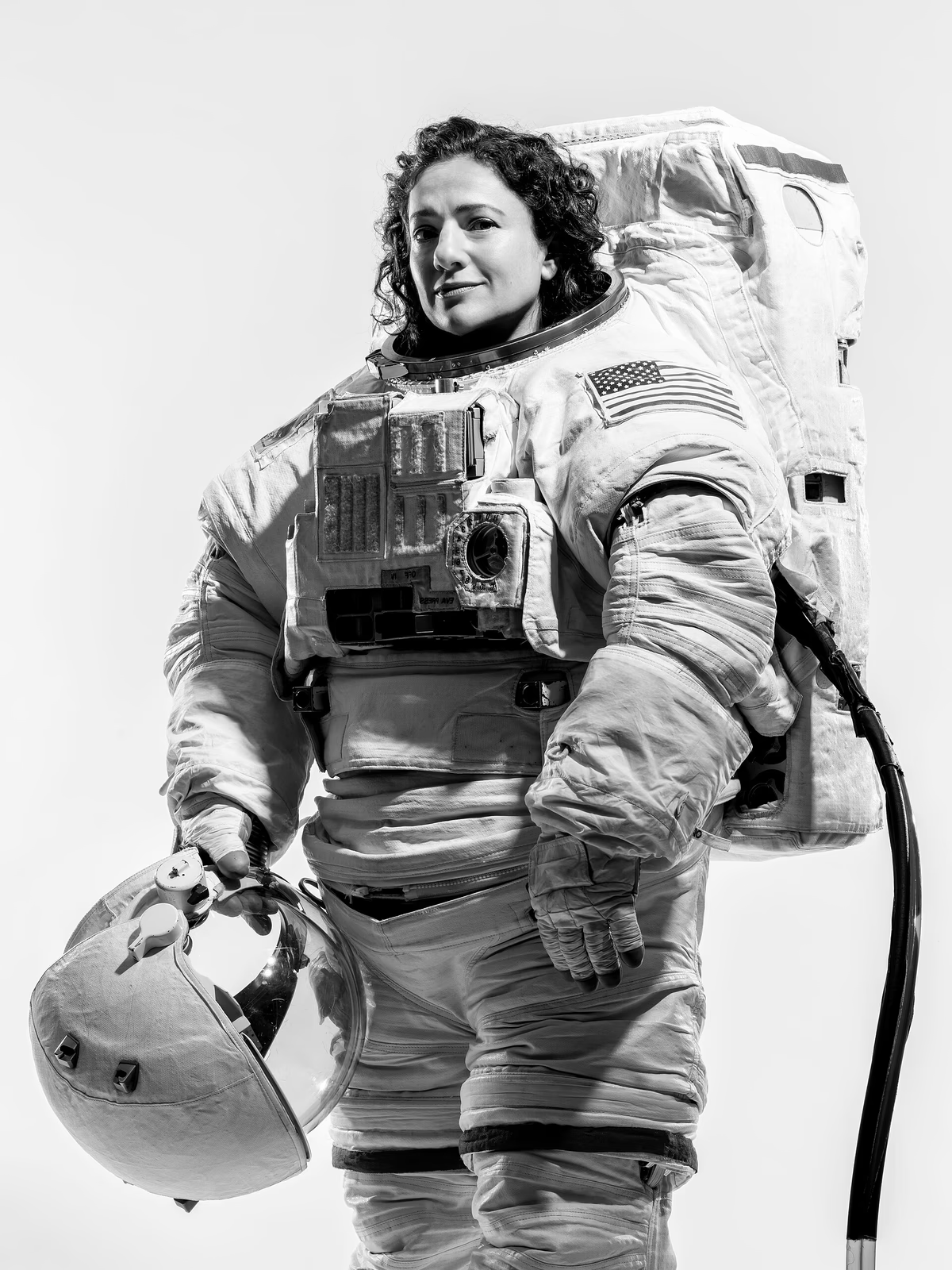
Photo: Jessica Meir official portrait in an EMU (B&W).jpg.jpg) by Josh Valcarcel — Public domain, via Wikimedia Commons.
Study Painting, Not Photography
Roversi's influences sit in art history rather than in the photographic tradition, and the practical version of that habit is more useful than it sounds.
Look at classical portraiture and note where the light comes from, how much of the frame the figure occupies, and what the background is doing. Look at how a painter handles the edge of a face against a dark background, which is a problem photographers solve with lighting and rarely study deliberately. Look at colour in old paintings, which is usually quieter than contemporary colour photography and closer to what Roversi produces.
The specific habits worth borrowing are unglamorous. A single dominant light source with a clear direction. Backgrounds that are darker or simpler than the subject. Fabric and skin rendered as texture rather than as colour. And a figure that occupies a deliberate proportion of the frame rather than filling it.
Practical Lessons From Roversi's Career
- Centre your subject boldly when the frame supports it rather than defaulting to the rule of thirds.
- Use continuous light and longer exposures for a softer, more present quality.
- Embrace simplicity: one subject, one idea, one carefully executed frame.
- Let subjects be still. Forced movement usually looks like what it is.
- Develop a consistent palette until it becomes part of your signature.
- Work slowly where the subject allows it, and treat the session as a sitting rather than a shoot.
- Study painting as much as photography.
- Print the work. Tonality and scale read differently on paper than on a screen.
Photo: 1994 contact sheet New Orleans by Infrogmation.jpg by Infrogmation of New Orleans — CC BY 2.0, via Wikimedia Commons.
Practical Tips
- Try central composition deliberately. It creates intimacy and directness that the rule of thirds cannot.
- Experiment with continuous lighting and longer shutter speeds for softer, more organic images.
- Build a consistent colour palette and hold it across a body of work.
- Study classical portraiture to understand how painters composed the human figure.
- Do not rush a portrait. The stillness in the final frame comes from time spent.
- Decide the concept and the light before the subject arrives, then spend the session on the person.
- Keep the background simpler and usually darker than the subject.
- Print your best frames and judge them at wall scale.
Further Reading
Conclusion
Paolo Roversi is the clearest available argument that restraint outperforms spectacle over a long career. His method is a single figure, centred, lit continuously, exposed slowly and printed carefully, repeated for decades until it became unmistakable.
The transferable part is not the large format camera. It is the decision to work slowly and to commit: to choose one idea per frame, to let a subject be still enough for something real to appear, and to build a palette and a compositional habit that nobody else uses in quite the same way. Trend-chasing produces work that expires. Commitment produces work that outlives the season it was made in.
FAQ
What camera does Paolo Roversi use?
He is known for large format cameras, particularly an 8x10 Deardorff, working with continuous light and long exposures. He has also used Polaroid film extensively for its soft, painterly quality, alongside digital work on certain projects.
Why does Roversi centre his subjects?
Centred composition removes the viewer's freedom to look elsewhere, producing directness and intimacy. Placing a figure in the middle of a pared-back frame is a deliberate choice about how the subject meets the audience, not an oversight of compositional rules.
What lighting technique is he known for?
Continuous, generally soft lighting with long exposure times rather than flash. The result is a glow and a softness that strobes rarely produce, and it requires the subject to hold still, which contributes much of the presence in his portraits.
How can I develop a style like Roversi's?
Study classical painting and portraiture, reduce your frames to one idea each, experiment with continuous light and longer exposures, and commit to an aesthetic rather than chasing new techniques. Consistency over years is what turns preferences into a signature.
Is slow photography practical for commercial work?
For portraiture and editorial work with a willing subject, yes. For fast-moving events and fashion week it is not, and Roversi's method suits the conditions he chooses to work in. The useful lesson is knowing when slowness is an advantage.
What is the single most transferable habit from his work?
Deciding everything before the subject arrives. When concept, framing and light are settled in advance, the time with the person is spent on the person, which is where the photograph actually comes from.