Business & Resources
Claudia Schiffer on Curating a Show of 1990s Fashion Photography
Claudia Schiffer was one of the most photographed women of the twentieth century, which makes her an unusual but well-qualified curator of its images. When s...
Claudia Schiffer was one of the most photographed women of the twentieth century, which makes her an unusual but well-qualified curator of its images. When she assembled Captivate!, an exhibition of 1990s fashion photography shown at the Kunstpalast in Düsseldorf, she brought the perspective of someone who had been inside the picture as well as in front of it.
Her reflections on the decade are more useful to photographers than most histories, because she is describing what the work felt like to make rather than what it looks like in retrospect.
Photo: Small boats old album photo vintage picture.jpg by E. P. Haddon, U.S. Fish and Wildlife Service — Public domain, via Wikimedia Commons.
The 1990s: When Fashion Photography Became Culture
"The 1990s made fashion photography and photographers a driving force in visual culture," Schiffer observes. "Because fashion photography is a democratic art form: you don't need a ticket to a museum to see it. It's on newsstands, billboards, and now on your phone."
That word, democratic, is doing important work. Fashion photography in that decade reached more people than any gallery could, and it shaped how a generation understood beauty, wealth and attitude. Supermodels became household names, campaigns became cultural events, and photographers became public figures in their own right. The audience was enormous, and it was not self-selected.
The consequence for photographers working today is worth thinking about carefully. If your images are seen by millions, the decisions about how you photograph a face, a body or a community are decisions with cultural consequences. Schiffer's observation is not a celebration of reach. It is a description of responsibility.
The Physicality of Pre-Digital Photography
Schiffer is precise about how different the technical process was. "Camera equipment was also much more costly and cumbersome back then and would include tripods, multiple lenses, and filters. The real magic happened in the moment because you couldn't fix everything in post."
That last clause describes a working condition that has largely disappeared. When retouching was slow, expensive and limited, the photograph had to be made correctly in the room: light positioned properly, exposure right, expression caught, composition settled. There was no rescue in post, so every decision carried weight.
What that constraint produced was judgement. Photographers who had to get it right in camera developed an ability to read a scene quickly and commit, and the images from the decade carry a conviction that is difficult to manufacture when everything is fixable later.
What Polaroids Taught Us
Polaroid tests were part of the standard workflow, used to check lighting, composition and pose before committing to film. Instant, but not repeatable, and each sheet cost money.
The effect on attention was the interesting part. Because the Polaroid was a one-shot check, everyone in the room looked at it carefully, adjusted, and looked again. It created a rhythm of practice and review during the shoot rather than after it, which is a discipline most digital photographers have lost in an era of an instant preview after every frame.
Anyone can reintroduce the same attention without owning a Polaroid camera. Set a deliberate budget: shoot a fixed number of frames, review them properly, change one variable, repeat. The scarce resource does not have to be film. It just has to exist.
Lessons From a Decade of Committed Images
Commit in the moment. Not everything can be fixed later, and work that assumes it can be is usually weaker for the assumption.
Study the masters of that era. Richard Avedon, Helmut Newton, Peter Lindbergh and Arthur Elgort were named in the exhibition's context, and each offers a distinct lesson: Avedon's plain backgrounds and confrontational scale, Newton's narrative provocations, Lindbergh's unretouched realism, Elgort's movement and lightness.
Keep the lighting simple and let it be dramatic. Much of the light in 1990s fashion work is a single source used decisively, which is both cheaper and more expressive than a complicated setup.
Build concepts that fit one frame. A 1990s image usually carries the whole idea, rather than relying on post-production elaboration.
Learn the history. Knowing what was done before is the difference between inventing and repeating.
Listen to experienced subjects. People who have been photographed hundreds of times can tell you when an image is working, and Schiffer has spent her working life doing exactly that.
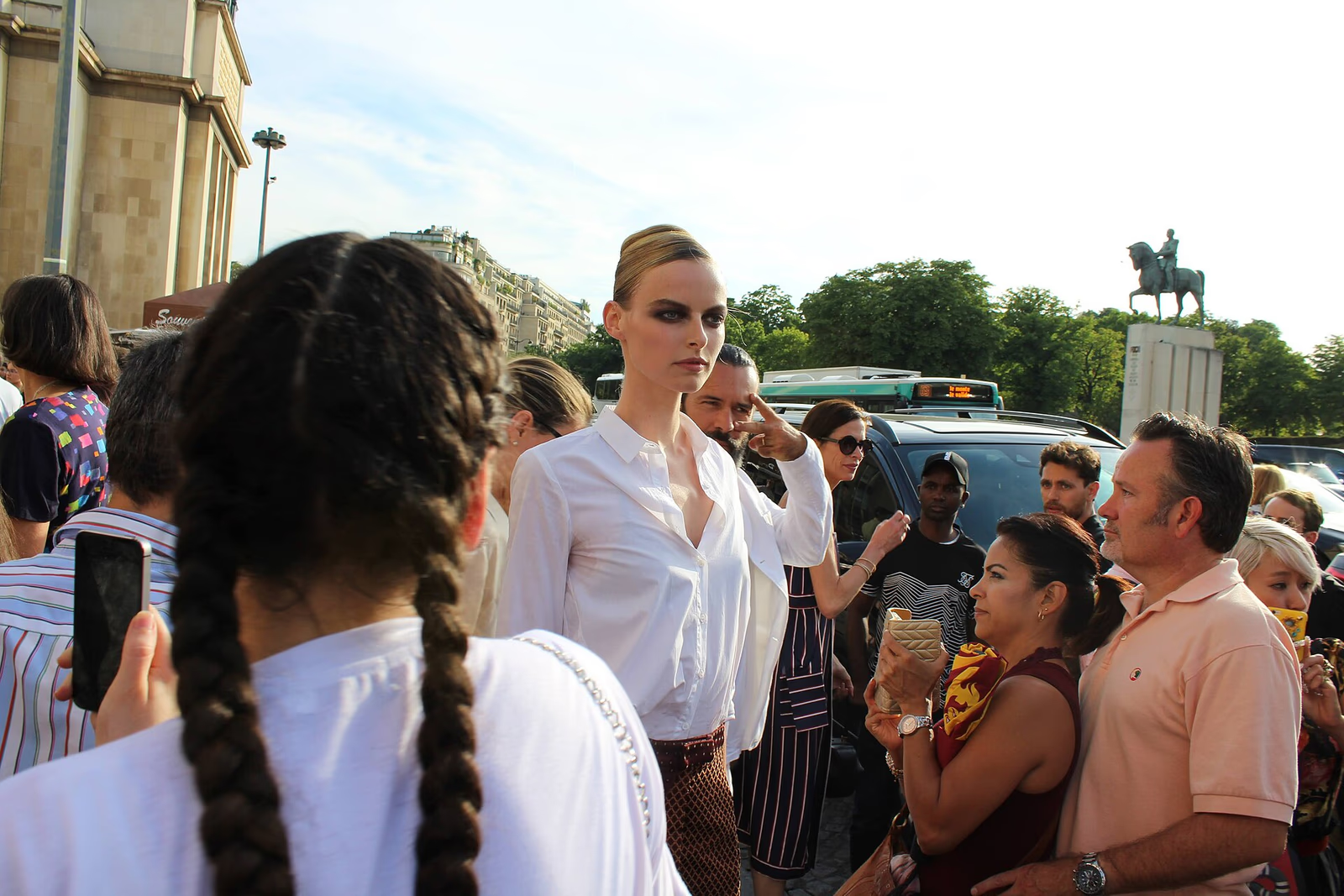
Photo: Supermodel Elza Matiz at Paris Fashion Week.jpg by FotoFern — CC BY-SA 4.0, via Wikimedia Commons.
What the Exhibition Format Changes
Curating an exhibition forces a different kind of looking, and it is worth borrowing the method even if you never hang a show.
Sequence beats selection. Individual images that carried a campaign change meaning next to each other. Order creates argument.
Wall size is part of the edit. An image that works in a magazine may not work at two metres, and one that is ordinary on a page can be extraordinary on a wall. Print your work and look at the difference.
Context must be visible. A photograph made in 1993 undersea with a supermodel next to it means something specific; without that context it becomes a picture of a dress. Exhibitions carry information that feeds carry badly.
The archive is the raw material. Schiffer curated a decade she had lived through and appeared in, and the show was assembled from the work of many photographers rather than one. Reviewing your own back catalogue with the same discipline is a useful exercise in seeing what you actually make, rather than what you intended to make.

Photo: Runway show in New York 2.jpg by IrinamykytiukELSAfairy — CC BY-SA 4.0, via Wikimedia Commons.
Practical Tips
- Shoot a roll of film or a small budgeted number of frames to practise committing to each one.
- Study the lighting in 1990s fashion work: frequently a single source, used decisively.
- Build concepts that work inside a single frame rather than relying on post-production.
- Learn the history of your genre. It is the difference between inventing and repeating.
- Use instant review properly: change one variable at a time rather than shooting endlessly.
- Print your best frames and judge them at wall size before deciding they are finished.
- Listen to experienced subjects. They can see what a photograph is doing.
- Remember the audience. Fashion imagery reaches people who never chose to look at it.
Further Reading
Conclusion
Claudia Schiffer's view spans the era of film, Polaroids and committed moments and the present, where almost anything can be constructed afterwards. Her argument is not nostalgic. It is that constraints were productive, and that the discipline of a decision made in the room is a skill worth keeping deliberately, even when technology no longer requires it.
For photographers working now, that is the useful part: you can shoot digitally, budget your frames, light with one source, print what matters and commit as if the image could not be altered. The constraint is available to anyone who chooses it. What is harder to recover, once lost, is the conviction that comes from having had no other option.
FAQ
What made 1990s fashion photography so influential?
A convergence of factors: supermodel culture, ambitious creative direction, and pre-digital constraints that forced photographers to get the image right in camera. The results carried a commitment and immediacy that audiences recognised, and fashion imagery reached a mass audience in a way it had not before.
How did Polaroids change the photography workflow?
They provided instant feedback before digital previews existed, so lighting and composition could be checked on set. Because each sheet cost money and could not be duplicated, they encouraged precision, attention and a rhythm of review during the shoot rather than afterwards.
What can modern photographers learn from 1990s technique?
The value of commitment. When post-production cannot rescue an image, the decisions made in the room become stronger. Budgeting frames, shooting film occasionally, keeping lighting to a single source and printing finished work all restore that discipline.
Which 1990s photographers should I study?
Peter Lindbergh for unretouched realism and mood, Helmut Newton for provocative narrative, Arthur Elgort for movement and joy, Steven Meisel for conceptual ambition, and Herb Ritts for sculptural composition. Richard Avedon's work from the period is equally instructive for its plain backgrounds and confrontational scale.
What was the Captivate exhibition?
Captivate! Fashion Photography from the 90s, curated by Claudia Schiffer and shown at the Kunstpalast in Düsseldorf, gathered work from photographers including Richard Avedon, Helmut Newton, Peter Lindbergh and Arthur Elgort to examine the decade in which fashion imagery became a mass cultural force.
Does film versus digital still matter?
Not as a moral question. What matters is whether the medium's constraints are present. Film supplies limitation automatically; digital requires you to impose it deliberately by budgeting frames, reviewing properly and committing to decisions instead of deferring all of them.