Posing & Portraits
Backstage Photography: Corey Tenold's 15 Best Candid Moments From Fashion Month
At the start of the autumn 2020 season, Vogue's behind-the-scenes photographer Corey Tenold noticed that something had changed. "The mood was definitely more...
At the start of the autumn 2020 season, Vogue's behind-the-scenes photographer Corey Tenold noticed that something had changed. "The mood was definitely more reserved," he explains. "I think people were being more cautious in general due to the coronavirus. Shows, for the most part, seemed quieter and more chill."
It did not stop him finding pictures. Across New York and Europe, Tenold photographed joy, tension and craft in the ten minutes before each show, in rooms where nobody stands still and nothing can be reshot. "The month is draining, there's no doubt about that," he says. "But the energy is infectious. Once the month is over and you've had some time off, you miss it. You miss the action, the friends, the traveling, the drama, the stories, the moments."
Below are his fifteen favourite backstage photographs from that season, and what each one teaches about working in a room that is moving faster than you are.
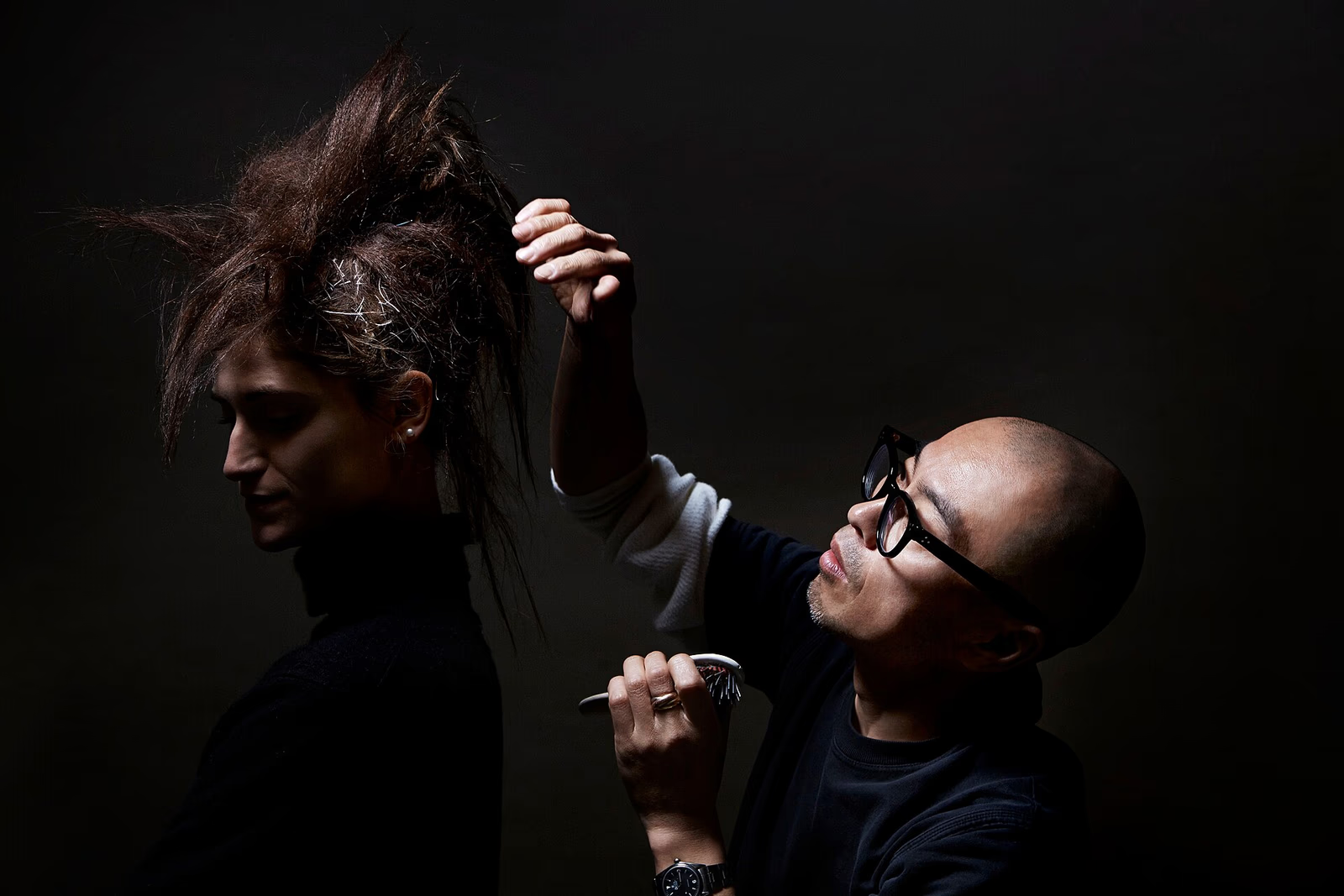
Photo: Haider Ackermann backstage at the Paris Fashion Week Fall-Winter 2015.jpg by Aveda Corporation — CC BY 2.0, via Wikimedia Commons.
Dries Van Noten: Embrace the Blur
"Capturing beauty in first looks can be challenging. However, when it does work out, it can be special. This moment was caught in a blur, but I loved the colors and the light reflecting off of her headpiece."
The lesson is not to delete imperfect frames immediately. Motion blur and soft focus can carry more feeling than a technically clean image, particularly when the blur is the only way to show how fast the moment was.
Halpern: Let the Details Guide You
"I loved the reflection that the flash created on these amazing pants! Also, I loved the way the hands looked with the nails matching the blue."
Tenold's eye goes to unexpected places: fabric texture, the reflection of a flash on a surface, colour coordination in details nobody styled deliberately. Training yourself to look past the obvious subject is most of what separates backstage work from event coverage.
Marc Jacobs: The Mirror Shot
"I saw Gigi taking photos on her disposable backstage at Marc Jacobs. When I asked to take her photo, she posed, but I asked her to pretend to take my photo as I took hers. I loved this result!"
This is one of the more useful techniques backstage: when your subject is also holding a camera, lean into the symmetry. Rather than asking someone to pose, give them something to do that mirrors what you are doing, and photograph that.
Carolina Herrera: Zoom Out for Context
"This moment greatly represents backstage. Zoomed out, we see the girl on a white backdrop. Normally you would just see a photo cropped in of the model with white behind. But by zooming out, you get more of a feel for what is really happening."
Backstage is an ecosystem, not a backdrop. Widening the frame to include the people holding the lights, steaming the garments and marking the floor plan tells the viewer something the close-up cannot.
Area: Composition Is Everything
"Love the colors, the pose, the shape of the outfit, and the hair."
Sometimes the simplest observation carries the most instruction. A good backstage photograph balances colour, form, texture and gesture inside one frame, and the balance is what makes it hold up beyond the season it was taken in.
Sies Marjan: Use the Architecture
"The venue for Sies Marjan was breathtaking. The fact that we got to shoot the girls against the glass was unbelievable. Some girls were too scared to stand against the windows, but Sora Choi had no fear."
When a venue gives you something extraordinary, use it without hedging. A glass wall, a staircase, a source of unusual light: those elements do work that no lens choice can substitute for.
Prada: Colour Is Emotion
"Loved all of the colors in this photo!"
Backstage palettes are frequently more vivid than the runway itself, because the lighting, the garments and the props pile up without anyone art-directing them. Sometimes the correct response to a scene is simply to photograph the colour.
Isabel Marant: Capture the Urgency
"This was directly after the Isabel Marant show. Adut Akech was trying to get my attention as she ran past. I loved the feeling of urgency this photo captured."
Backstage is not static. The kinetic frames, where something is genuinely happening at speed, are usually worth more than a considered portrait, and they only exist for a second.
Marc Jacobs: The Candid Moment
"I really caught a moment here with Fran Summers that I loved."
No setup, no direction, just being present when something real occurred. The discipline is attentiveness rather than invention: watching for the two seconds when a face stops managing itself.
Dior: Let the Subject Lead
"Sora always serves up something interesting. I try my best not to direct models backstage and just capture what I see, and she took the bag up to her face by herself here."
Tenold's working philosophy is documentary rather than directorial, and it is worth taking seriously. Direction interrupts whatever the room was already doing, and the room is usually more interesting than your idea.
Balmain: Range of Moods
"I love the wide range of moods in this photo, from happy to disinterested."
Group frames backstage are unusually rich because they hold several separate experiences at once. One person is laughing, one is bored, one is looking at the door. That simultaneity is what a room full of people actually looks like.
Chanel: The Power of a Stare
"The stare in this photo caught me as I was editing. The fog in the background also helped set the mood."
Direct eye contact backstage is rare, and it is why the frames that contain it feel different from the rest. Combined with a background that removes context, a stare becomes the entire subject of the photograph.
Rodarte: Happy Accidents
"Sometimes mistakes can create the best photos. I think my flash didn't fire on this shot, but as I was editing, instead of skipping over it, I saw something here."
This is the most practical lesson in the set. A flash that failed, an exposure that is wrong, a strange colour cast: these are the frames most people delete, and they are sometimes the only frames that do not look like everyone else's.
Central Saint Martins: Trust Your Instincts
"It's funny, these designs from Leeann Huang caught my eye the most while shooting backstage at the CSM show. Turns out, she ended up being one of the grand-prize winners."
If something catches your eye, there is usually a reason, even before you can articulate it. Photographing the thing you cannot justify yet is how a body of work develops a point of view.
Hermès: The Unassuming Moment
"There is a lot of movement backstage. Sometimes I catch an unassuming moment that just seems to work."
The quietest frames are frequently the strongest, because they are the ones no one else in the room stopped to look at. A glance, a hand adjusting a strap, someone reading a message with their shoes off: that is what the day was actually like.
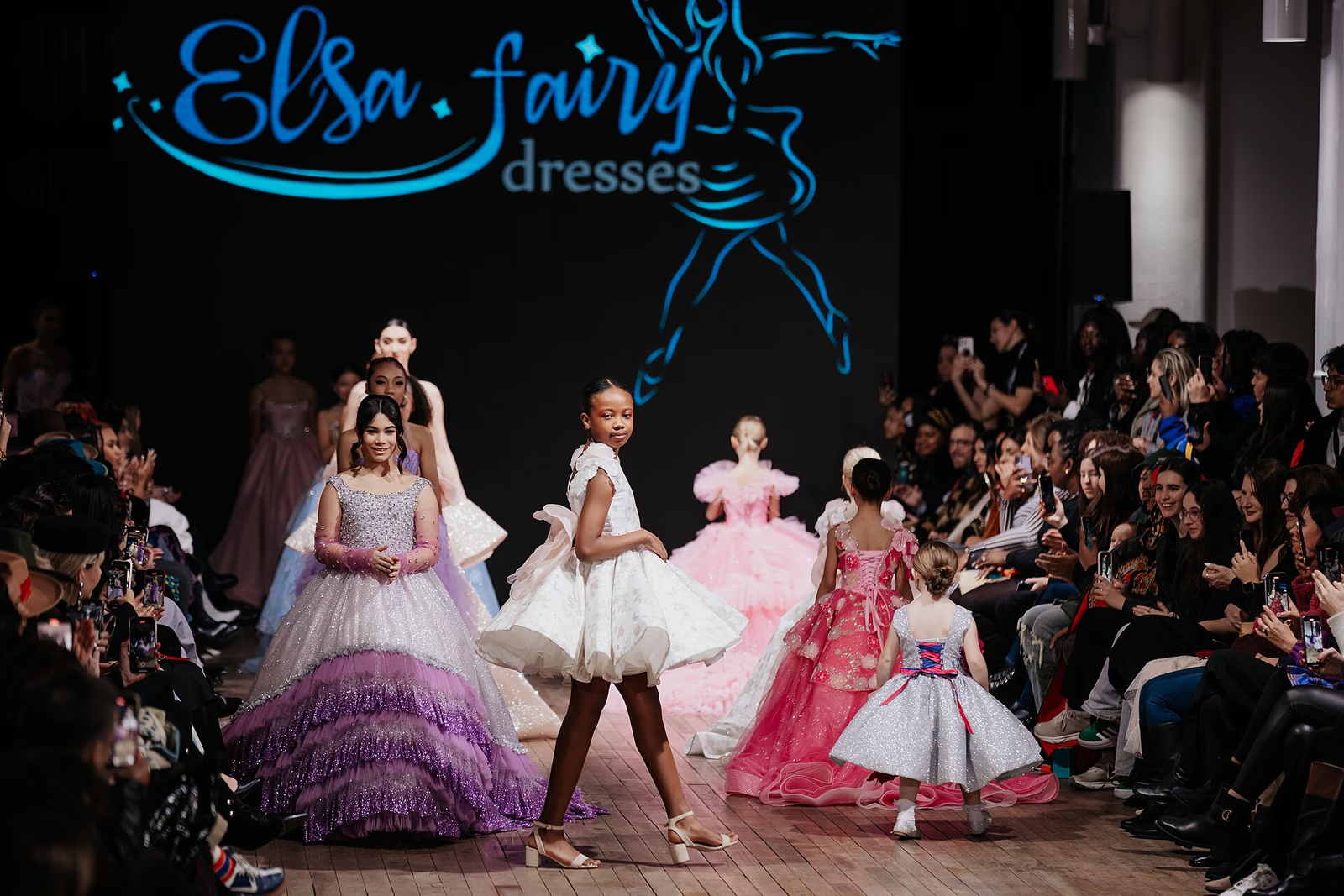
Photo: Runway show in New York 1.jpg by IrinamykytiukELSAfairy — CC BY-SA 4.0, via Wikimedia Commons.
What the Fifteen Frames Have in Common
Across shows, cities and designers, the same few decisions recur, and they explain why Tenold's backstage work looks different from the flood of images produced at the same events.
He does not direct. The exception is the mirror shot at Marc Jacobs, and even there the instruction gave the subject something to do rather than a pose to hold. Documentary discipline is what keeps backstage pictures honest.
He photographs the room, not the garment. The garments will be photographed properly on the runway by other people. What is only available backstage is the ecosystem: hands, steam, cables, and the specific boredom of a person waiting to walk.
He keeps the mistakes. Blur, missed flash, wrong exposure. Technical errors are also the only frames that arrive without a template attached.
He looks at details rather than subjects. Reflections, nails, colours, textures. Attention to the small things is what makes an image legible when the subject is not looking at you.
He edits patiently. Several of the frames above were found during editing rather than at the moment of capture, which is an argument for leaving your own work alone for a few days before deciding what it is.
Practical Tips on Working Backstage
- Shoot fast primes, keep the shutter at 1/250 or faster, and let Auto ISO absorb the changing light.
- Stay mobile and quiet. Work from the edges, and do not stand between a dresser and a model.
- Do not direct unless it is necessary. Give subjects something to do rather than a pose.
- Zoom out occasionally and photograph the production as well as the person.
- Use the venue: glass, staircases and awkward corners are opportunities, not obstacles.
- Keep the blurry, badly exposed and accidental frames. Review them rather than deleting on sight.
- Arrive early. The most useful ten minutes backstage are the ones before the crowd.
- Learn names and keep good relations with the PR team. Access is granted to people who do not cause problems.
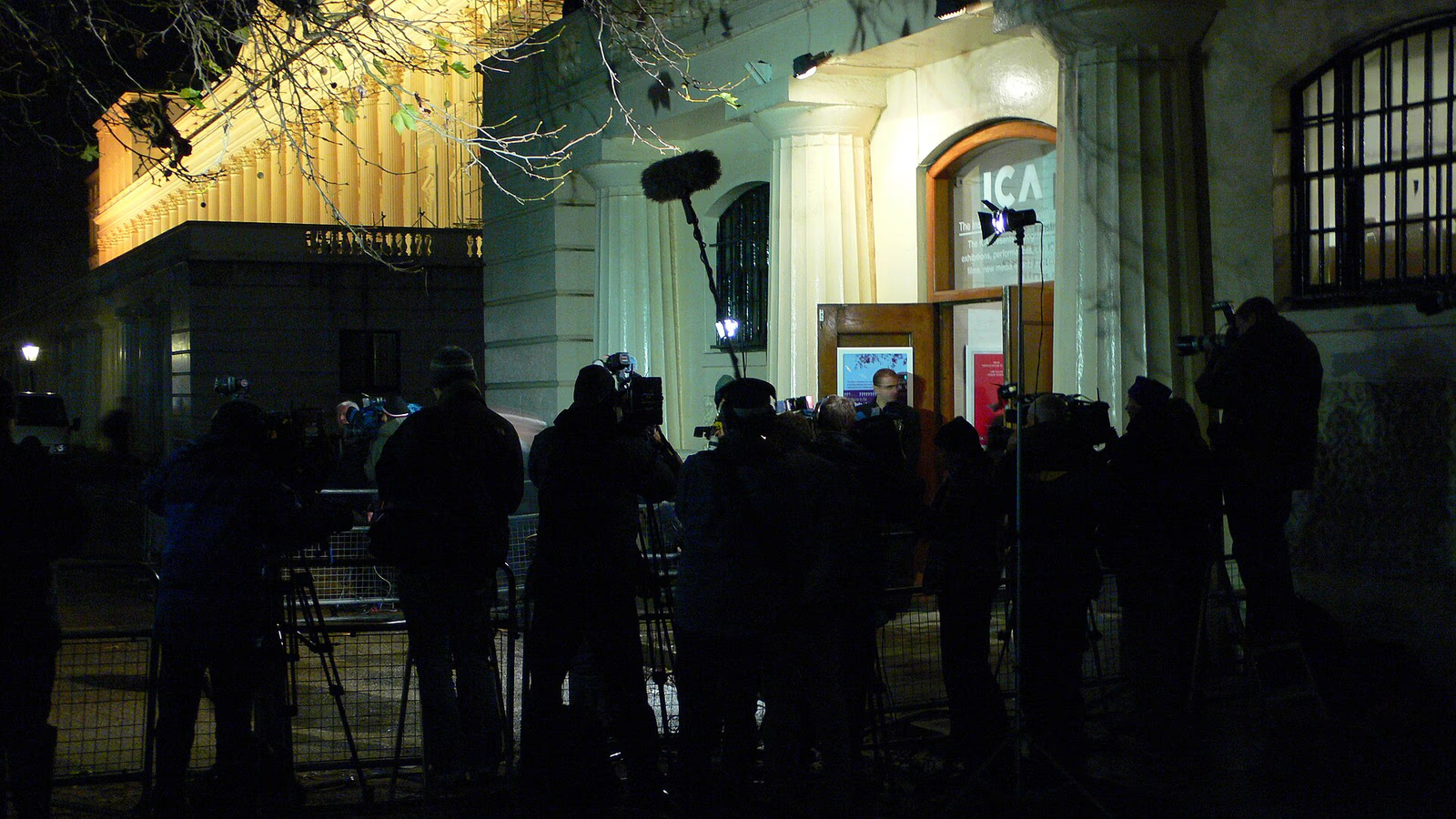
Photo: Paparazzi ICA Decemeber 2005 1.jpg by Unknown — CC BY-SA 2.0, via Wikimedia Commons.
Further Reading
Conclusion
Corey Tenold's backstage work is a lesson in observation rather than technique. He does not direct, does not impose, and does not discard his mistakes, and the result is a set of images that show what a fashion week actually felt like rather than how it was meant to look.
The principles transfer to any fast, crowded, badly lit environment where nothing can be repeated: be present, keep your footprint small, look at the details, trust the thing that catches your eye for reasons you cannot explain yet, and go back through the imperfect frames before you throw them away.
FAQ
How do you get access to shoot backstage at fashion shows?
Access usually requires press credentials, a publication affiliation or an invitation from the brand's PR team. Most photographers start with smaller shows and local publications, deliver consistently, and build relationships over seasons. It is granted to people who are reliable and do not create problems.
What camera settings work best backstage?
A fast lens, somewhere between f/1.4 and f/2.8, is essential for dim and unpredictable light. Keep the shutter at 1/250 or faster to freeze movement, use Auto ISO for the changing conditions, and shoot RAW so mixed colour temperature can be corrected.
How do you capture candid moments without being intrusive?
Stay on the edges of the room, use a small camera, and avoid directing people. Tenold's approach is to observe rather than impose, which consistently produces more honest frames than heavy direction, and which also keeps you invited back.
Why keep blurry or technically flawed photographs?
Because mistakes are the only frames that arrive without a template. A missed flash or motion blur often produces an image that no other photographer in the room has, and Tenold found at least two of his favourites while editing rather than shooting.
What makes a great backstage photograph?
Something beyond the clothes: emotion, urgency, intimacy or an unexpected detail. The strongest backstage images show the human reality behind the runway's polish, so that a viewer feels they were in the room rather than shown a summary of it.
How many photographs should you deliver from a fashion month?
Fewer than you shoot, and fewer than a client asks for. Fifteen strong frames that each teach or reveal something will be remembered far better than five hundred that document everything and argue for nothing.